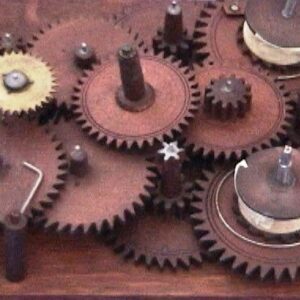
German Clockmakers: Hamburg American, Junghans and Gustav Becker
 Paul Landenberger started out as a bookkeeper for the Junghans clock factory in Schramberg, Germany. He advanced in the company to an authorized executive business manager. Landenberger married Frida Junghans, daughter of company founder Erhard Junghans. In 1872 Landenberger demanded a position on the board of directors. The Junghans family declined his request and Landenberger left the company in anger. This was the beginning of a long family feud. In 1875, together with his partner, Philipp Lang, he founded the company Landenberger & Lang clock factory. He had taken some know-how from his experience at Junghans, but the company was bankrupt by 1882/1883. In 1883 converted to a stock holding firm and with new investors, the company was re-named to Hamburg-Amerikanische Uhrenfabrik (Hamburg American clock factory). Also known as HAC.
“Hamburg” appeared in the name, because the investor coming from Hamburg wanted it that way. “Amerikanische” was connected to the movements that were made by the new efficient American production methods. The older company logos of HAC may not be as familiar as the well known “Pfeilkreuz” (Crossed Arrows) mark, registered in 1891.The company used many different trademarks but the best known is the “crossed arrows” symbol.Later the discount “Lux” trademark with the logo of a burning oil lamp in 1905.
The competition with Junghans, was fierce. HAC managed to flourish. HAC built its own worker’s homes housing district.By the mid 1920s HAC, Junghans and Gustav Becker were forced to cooperate because of dropping sales figures and economic depression. Junghans gained influence by this cooperation and in 1930 was able to completely take over both companies (HAC and Gustav Becker).
 Erhard Junghans, founder of the Junghans factory. Died in 1876. Junghans History

Junghans Factory
Much of the old HAC factory, including all of their archives, were destroyed during a flood in 1959.
HAC movements cannot be dated by serial numbers or dating codes prior to the takeover by Junghans. Some of the movements displayed both the HAC and the Junghans star.

Hamburg Amerikanische Uhrenfabrik
 Gustav Becker (1819-1885)
Gustav Becker learned the craft of watch making in Silesia (now part of Poland)and extended his knowledge on trips to watchmakers in Germany, Austria and Switzerland.These trips enabled him to refine his craft and to become an outstanding watchmaker. During his time in Vienna he wished to establish a watch factory. In 1847 Becker opened a watch shop in Freiburg. This is a town in the province of Lower Silesia, Poland.
In 1854 he had a large order for the Royal Mail and the Telegraph Office of Silesia.The Duke of Ratibor gave him a generous loan with which he could build near the train station.From this factory the simple pendulum clocks were soon replaced in 1860 by more elaborate clocks with richly ornamented and carved housings for high quality works.

Clock Movement Trademark Identification – German Clockmakers
Antique Clock Museum of German clocks – German Clockmakers
All the clock and watch repair courses are now available online and are all viewable on the new Tick Tock Productions Online School Additionally, there is an online library consisting of over 85 classic and rare watch and clock repair books with more watch and clock videos.
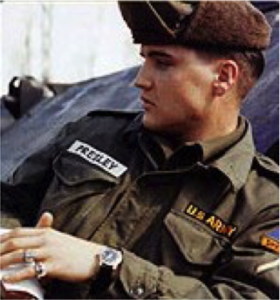 Elvis Presley once owned this 1960 black dialed Omega Constellation Calendar. It was auctioned by Antiquorum of New York on June 12, 2012 for the final hammer price of $52,500. The auction pre-sale estimate was a range of 10,000 to $20,000. The watch is an automatic chronometer movement in a steel case with rose gold plating. It is a piece of rock and roll history. The watch came from a private collection belonging to Charlie Hodge who was a close friend of Elvis Presley. Elvis gave the watch to Hodge while still in the army after Hodge expressed admiration for the watch.
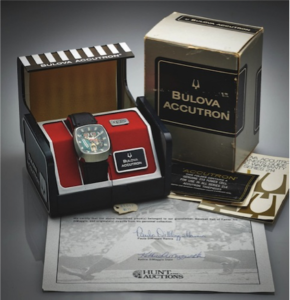 Joe DiMaggio, the baseball hall of famer, once owned this Bulova Accutron. It is a water resistant, stainless steel case with an electronic movement. It was sold on April 10, 2013 at Antiquorum. It was accompanied by a certificate signed by DiMaggio’s granddaughters verifying the provenance. The watch was part of the auction “Important Modern & Vintage Timepieces”. The initial pre-sale estimate was $4000. It sold for $20,625. The watch appeared to be unworn.
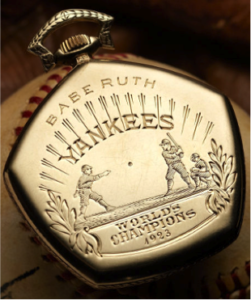 Babe Ruth’s world-series Gruen Pocket Watch. Before the major league baseball players were awarded world-series rings for winning the world-series, the teams would celebrate their win by giving their players a commemorative watch. In 1923, the New York Yankees beat the New York Giants in 6 games to win the first world-series. The most treasured of these watches is the one owned by the New York Yankee Babe Ruth. His watch is a Gruen Verithin 1923 world-series championship pocket watch made of 14 carat gold. It was auctioned by Heritage Auctions on February 22, 2014. The final hammer price was $717,000.
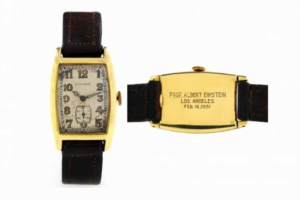 Albert Einstein once owned a Longines wristwatch. It is a tonneau-shaped 14 carat gold watch. On October 16, 2008 Antiquorum auctioned the 1930 Longines watch owned by the famous scientist. The backside shows an etching featuring Einstein’s name, Los Angeles and the date of 1931. The auction estimate was $35,000. The final hammer price went for $596,000. This is a record for the highest selling Longines watch.